
Lending Without Interest (Qard Hasan)
In Islam, lending money without charging interest — known as Qard Hasan — is regarded as a charitable act. Unlike conventional loans that may incur profit or interest, a Qard Hasan is given purely to assist others without expecting any return beyond the principal amount. This aligns with the Quranic directive to help those in need without exploitation: “Who is it that would loan Allah a goodly loan so He may multiply it for him many times over?” (Quran 57:11).
Prophet Muhammad (Peace Be Upon Him) encouraged acts that ease burden and support communal welfare. Offering interest-free loans can empower people experiencing financial hardship, providing relief and fostering a more equitable society.
Sharing Knowledge and Teaching Others
Charity in Islam extends far beyond monetary help; sharing beneficial knowledge is another significant form of giving. Teaching others valuable skills, religious understanding, or practical information counts as sadaqah because it benefits individuals and communities long term.
As Prophet Muhammad (Peace Be Upon Him) said, “When a man dies, his deeds come to an end except for three things: ongoing charity, knowledge from which others benefit, or a righteous child who prays for him” (Sahih Muslim).
This highlights that imparting education and wisdom can create lasting positive impact that continues beyond one’s lifetime.
Volunteering Time and Skills
Donating time and skills is another powerful form of charity. Whether helping in community projects, supporting those in need, or offering professional expertise, volunteering reflects care and solidarity.
Such contributions are practical demonstrations of compassion and responsibility, strengthening social bonds. The Prophet (Peace Be Upon Him) stated, “The best charity is given by one who can hardly spare it, and whoever abstains from asking others for help Allah will give him and suffice him” (Riyad as-Salihin).
This encourages giving selflessly regardless of one’s own circumstances, emphasising the value of effort and presence alongside financial aid.
Acts of Kindness and Continuous Charity
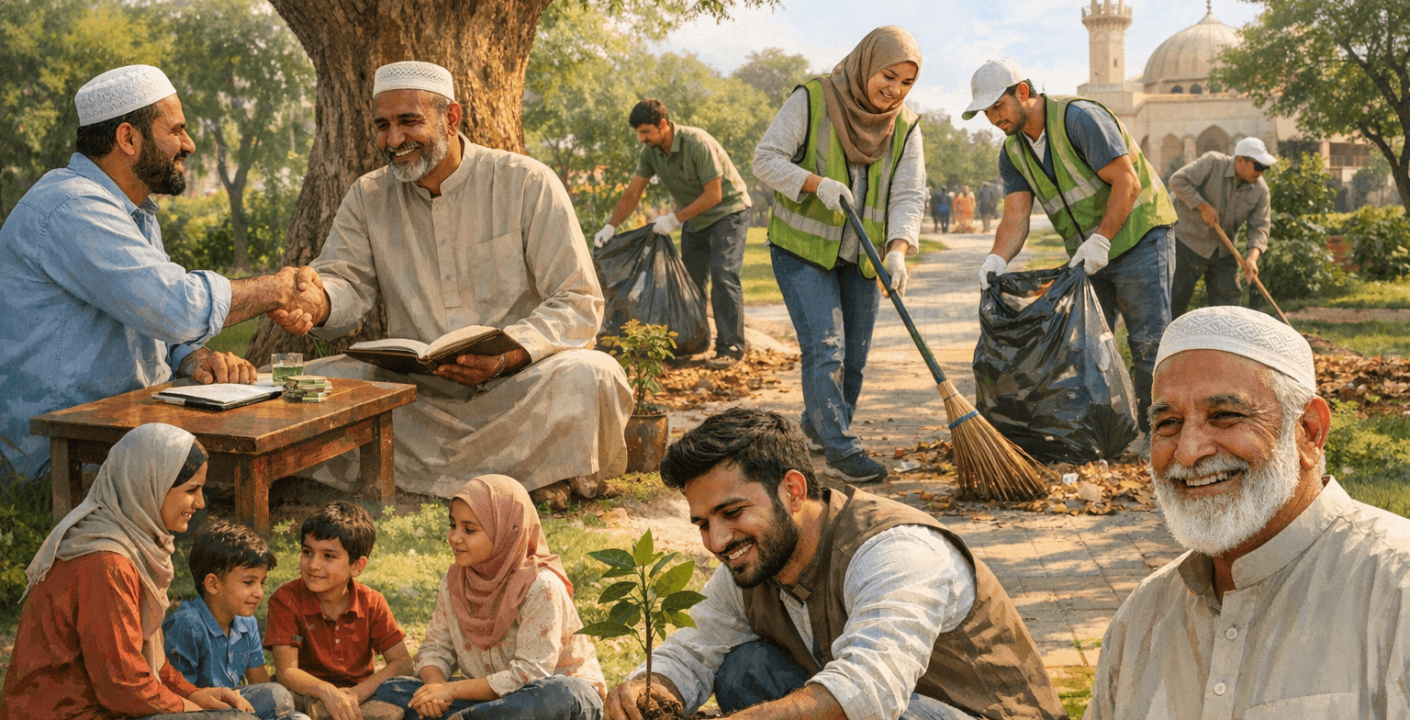
Several forms of charity are accessible to anyone at any time, including simple acts of kindness. For example, removing harm from the path—such as clearing obstacles or hazards—is mentioned by the Prophet (Peace Be Upon Him) as a charitable act even without expense (Riyad as-Salihin).
Similarly, smiling and speaking kindly are viewed as charity; a smile costs nothing but can brighten someone’s day (Sahih al-Bukhari).
Continuous charity or Sadaqah Jariyah refers to acts with lasting benefit, such as planting trees or providing water sources. The Quran praises those whose deeds outlive them: “The example of those who spend their wealth in the way of Allah is like a seed growing seven ears, in every ear a hundred grains” (Quran 2:261).
Providing essential resources like wells or trees supports communities for years, multiplying the reward.
Furthermore, advocating for justice and standing up for the oppressed is a charitable service that upholds the core Islamic principle of fairness: “O you who believe, be persistently standing firm for Allah, witnesses in justice” (Quran 4:135). Speaking out against injustice supports dignity and peace.